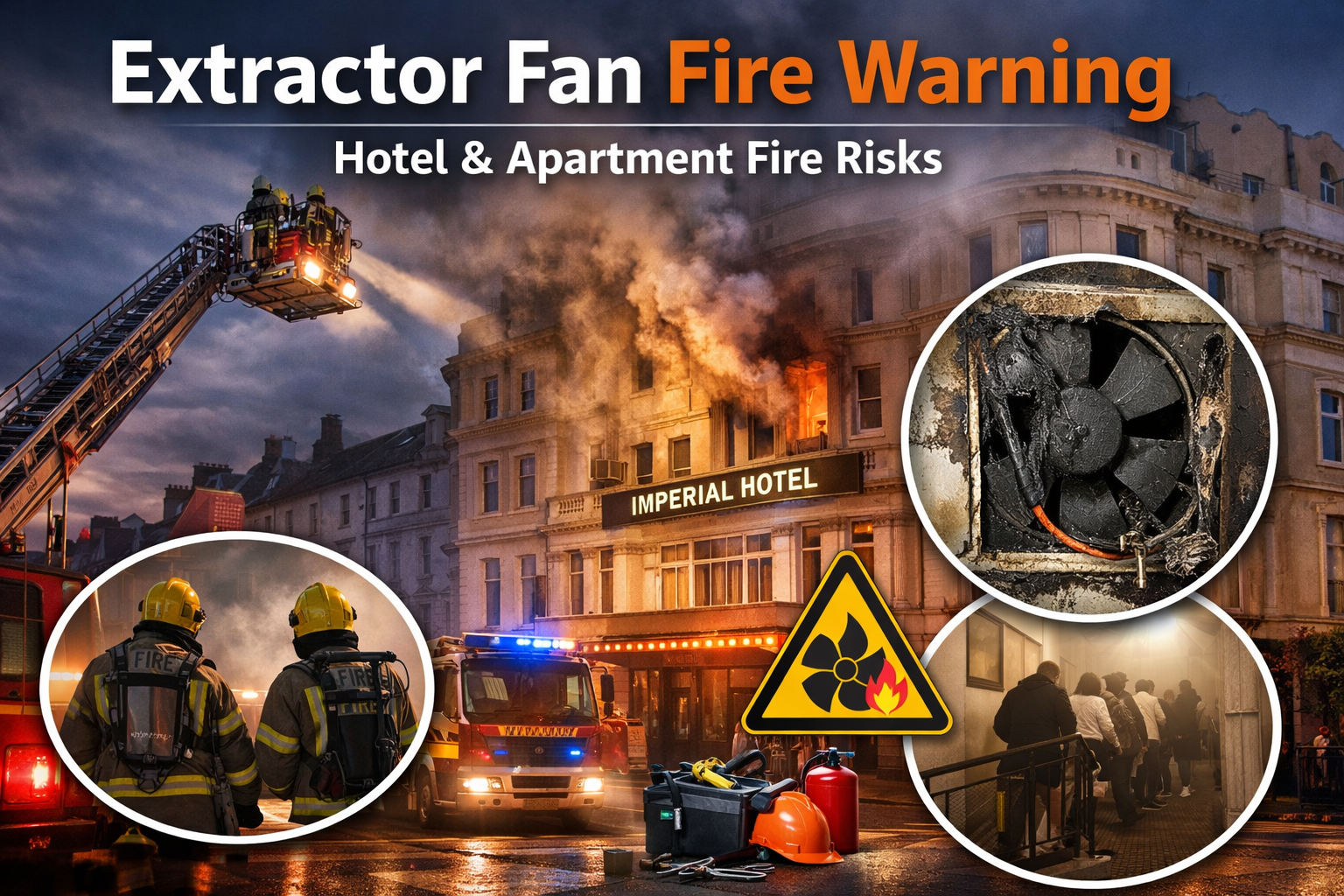
Firefighters have confirmed that a faulty extractor fan was responsible for a hotel fire that forced the evacuation of guests and staff at a prominent seaside hotel in East Sussex, reinforcing concerns about the fire risks associated with poorly maintained ventilation and electrical equipment in hotels, flats and other multi-occupancy buildings.
The fire occurred at the Imperial Hotel in Hove on 24 December 2025, prompting a significant emergency response.
While no injuries were reported, fire services say the incident is a clear reminder that extractor fans — often hidden from view — can become a serious ignition source if not properly assessed and maintained.
What happened at the Imperial Hotel?
The East Sussex Fire and Rescue Service (ESFRS) said crews were called to the hotel on First Avenue at approximately 15:10 GMT following reports of a fire on the fourth floor of the Victorian building.
Multiple fire engines attended, supported by an aerial ladder platform to reach the upper floors. Six firefighters wearing breathing apparatus entered the building to tackle the fire, while police and the South East Coast Ambulance Service were also on scene as a precaution.
The hotel was evacuated while crews worked to extinguish the blaze and prevent further spread. Firefighters later remained on site to damp down hot spots and ventilate smoke from the building.
Following a full investigation, ESFRS confirmed:
“The cause of the fire was accidental, due to a fault with an extractor fan.”
An underestimated but recurring fire risk
Extractor fan fires are not isolated incidents. National fire data consistently shows that electrical faults remain one of the leading causes of fires in both domestic and non-domestic buildings across the UK.
Extractor fans present a particular risk because they:
- Operate frequently or continuously
- Contain motors and electrical components
- Accumulate dust, grease and lint over time
- Are often installed in ceiling voids or ductwork where faults can go unnoticed
In hotels, extractor fans may run for extended periods in bathrooms, kitchens and service areas, increasing wear and the likelihood of failure if routine maintenance is missed.
Dust and grease: a dangerous combination
Fire investigators regularly identify build-up of combustible material as a key factor in extractor fan fires. Dust and grease can collect around motors, bearings and wiring, providing fuel if overheating or an electrical fault occurs.
Over time, this combination can allow a small fault to develop into a fully established fire, particularly where:
- Fans have exceeded their intended service life
- Internal cleaning has not been carried out
- No inspection records exist
- Fans are not suitable for continuous operation
A similar incident in Maidenhead
The Hove hotel fire follows a strikingly similar incident in Maidenhead, Berkshire, earlier in 2025. In August, firefighters were called to Crescent Dale, off Shoppenhangers Road, after an extractor fan caught fire inside a flat.
Smoke spread rapidly through the building via ventilation routes, forcing the evacuation of around 50 residents. Fire crews attended with four fire engines, using breathing apparatus, hose reels and extinguishers to bring the blaze under control.
Although no one was injured, the fire caused extensive smoke damage. One flat also suffered significant water damage after heat from the extractor fan fire burst a pipe in the property above. Firefighters remained on site for around two hours, ventilating the building and ensuring it was safe for residents to return.
Why extractor fan fires spread quickly
These incidents highlight how extractor fan fires can escalate rapidly. Ventilation systems can act as pathways for smoke and fire, allowing smoke to spread far beyond the room of origin.
In hotels, flats and HMOs, shared ductwork and risers can affect multiple floors, increasing the risk to occupants and complicating evacuation. This makes early detection, containment and maintenance especially important.
Fire risk assessments and maintenance routines: a critical control measure
Both the Hove and Maidenhead fires underline the importance of including extractor fans and ventilation systems within a suitable and sufficient fire risk assessment.
Extractor fans combine electrical components, heat and combustible deposits, making them a recognised ignition source if not properly managed. A robust fire risk assessment should consider:
- The type and location of extractor fans
- Whether fans are suitable for continuous or high-duty use
- The risk of dust, grease and lint accumulation
- The potential for smoke and fire spread through ductwork and risers
- Whether inspection, cleaning and replacement intervals are adequate
Fire risk assessments must not be static documents. Where equipment ages, layouts change, or incidents occur, assessments should be reviewed and updated, with findings acted upon promptly.
The importance of proper maintenance
Routine maintenance is one of the most effective ways to prevent extractor fan fires. For hotels, residential blocks and managed properties, this should form part of a planned maintenance regime, carried out by competent persons.
Effective maintenance routines typically include:
- Periodic internal cleaning of fans and ductwork
- Electrical checks on motors, bearings and wiring
- Early replacement of noisy, overheating or aging units
- Clear maintenance records to demonstrate compliance
When extractor fans are properly maintained and their risks are identified and controlled through the fire risk assessment, the likelihood of ignition is significantly reduced.
Legal responsibilities for responsible persons
Under the Regulatory Reform (Fire Safety) Order 2005, responsible persons must take reasonable steps to reduce fire risks arising from electrical installations and equipment.
This includes:
- Identifying ignition sources
- Maintaining systems in efficient working order
- Acting on known defects
- Preventing the spread of fire and smoke
Failing to manage extractor fan risks can expose duty holders to enforcement action, prosecution and civil liability if a fire occurs.
Official sources
The original report on the Hove hotel fire was published by BBC News:
🔗 Extractor fan caused hotel fire, say firefighters – BBC News
https://www.bbc.co.uk/news/articles/cev8w238djno
The Maidenhead flats incident was reported by the Maidenhead Advertiser:
🔗 Dozens evacuated after extractor fan fire fills Maidenhead flats with smoke
https://www.maidenhead-advertiser.co.uk/news/emergency-services/203230/dozens-evacuated-after-extractor-fan-fire-fills-maidenhead-flats-with-smoke.html
A preventable risk
While both incidents ended without loss of life, they are clear warnings. Extractor fan fires are often preventable, yet continue to disrupt buildings, displace occupants and place firefighters at risk.
For hotels, landlords and property managers, extractor fan maintenance should be treated as a core fire safety control, supported by robust fire risk assessments and documented maintenance routines. Small, hidden faults can escalate quickly — but with the right controls in place, they do not have to.