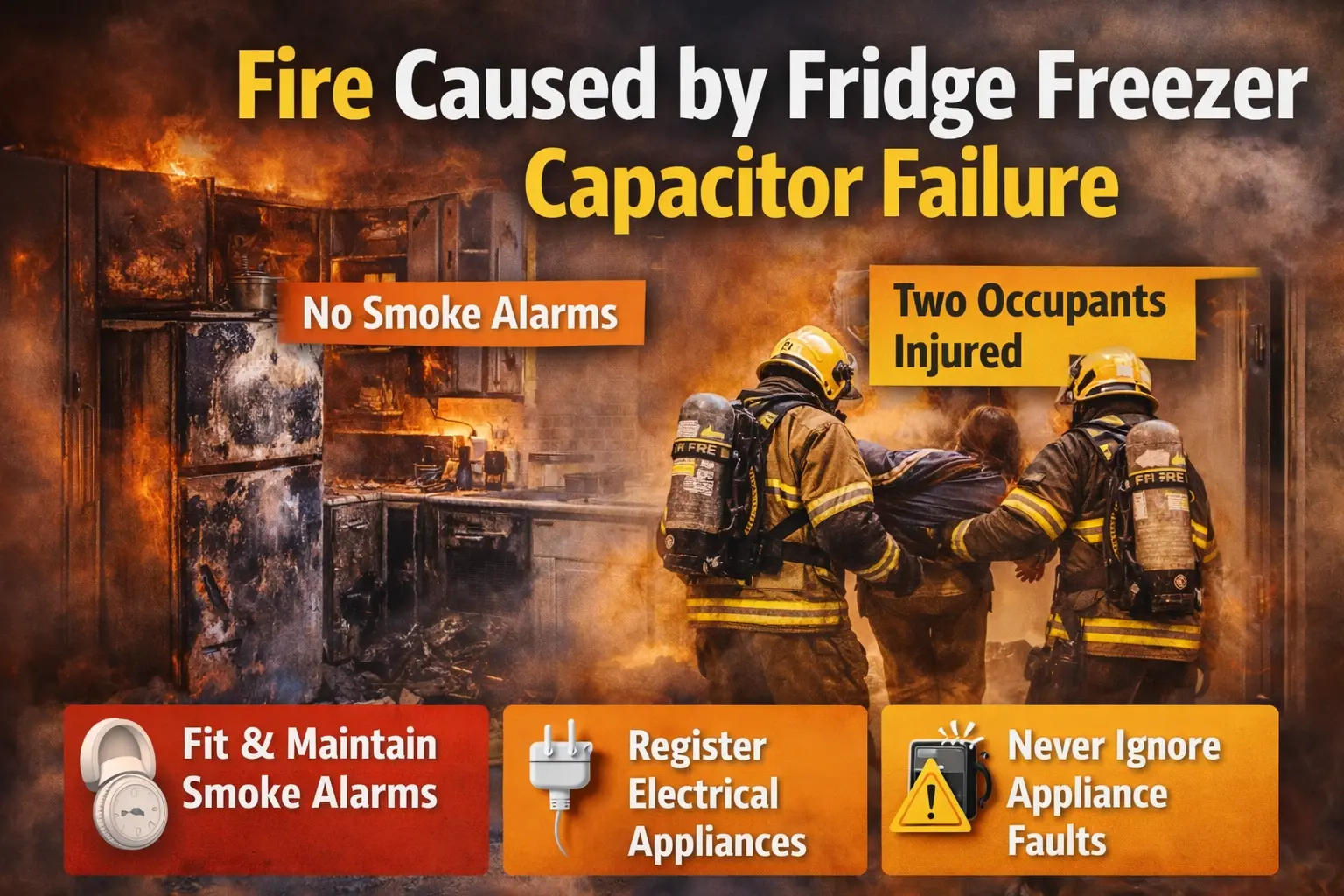
A serious flat fire caused by a capacitor failure in a fridge freezer has highlighted the hidden risks posed by everyday electrical appliances — and the potentially life-changing consequences when early warning systems such as smoke alarms are missing.
The incident occurred in the early hours of the morning in a first-floor flat within a purpose-built residential block of five storeys.
While both occupants survived, the fire caused extensive damage to the property and resulted in serious injuries, underlining how quickly a fault in a single appliance can escalate into a major emergency.
How the fire started
Fire investigators later confirmed that the blaze originated from a faulty capacitor within the fridge freezer, which was located in the kitchen. Capacitors are small electrical components used to regulate power within appliances, but when they fail, they can overheat, short-circuit and ignite surrounding materials.
The fire spread rapidly from the kitchen into the hallway, generating dense smoke and intense heat. The kitchen and hallway suffered severe fire damage, while the remainder of the flat was extensively affected by heat and smoke.
Because the fire occurred while the occupants were asleep, it developed for a period of time before being discovered — a factor that significantly increased the danger.
Occupants trapped by smoke and fire
The flat was occupied by two adults at the time of the incident. One occupier woke to find smoke entering the bedroom and managed to escape the property and raise the alarm.
The second occupier, an adult female, was trapped by the fire and smoke and was later found unconscious in her bedroom by firefighters wearing breathing apparatus. Fire crews rescued her from the flat and both occupants were treated for smoke inhalation and burns.
Although both individuals eventually recovered, the female occupant remained in hospital for several weeks, highlighting the serious and lasting impact of domestic fires — even where lives are saved.
The wider impact of the fire
Beyond the immediate injuries, the effects of the fire were far-reaching:
- The flat was badly damaged and required extensive repairs before it could be made habitable again
- Heat from the fire caused water pipes to fail, leading to water damage in the flat below
- The emotional and psychological effects of the incident are likely to be felt long after physical recovery
This incident demonstrates how fires in flats can quickly affect multiple properties, increasing disruption, repair costs and risk to other residents.
A critical safety failing: no smoke alarms
One of the most serious findings was that no smoke alarms were fitted in the flat.
A working smoke alarm installed in the hallway would likely have activated at a much earlier stage, alerting both occupants while escape routes were still usable. Early warning is often the difference between a safe escape and life-threatening injuries.
Fire services consistently advise that:
- Smoke alarms should be fitted on every level of a home
- Alarms should be tested regularly
- Batteries should never be removed or allowed to fail
Electrical appliances: a hidden risk
Fridge freezers are designed to operate continuously, often for many years. As appliances age, internal components such as capacitors can degrade, increasing the risk of failure.
To reduce risk, residents are advised to:
- Avoid using damaged or overheating appliances
- Keep ventilation areas around appliances clear
- Switch off and unplug appliances if unusual smells, noises or heat are noticed
- Never ignore signs of electrical faults
If there is any doubt about an appliance’s safety, it should not be used until checked by a competent person.
Product registration and recalls
This incident also reinforces the importance of registering electrical appliances with the manufacturer. Registering ensures that consumers can be contacted if:
- A safety defect is identified
- A product modification is required
- A product recall is issued
Many fires linked to appliances involve products that were subject to recalls, but occupants were never notified because the appliance was not registered.
If you did not register your appliance when it was first purchased, you can still do so. You can also check whether any of your appliances are currently subject to a recall by using recognised product recall search services.
A simple message that saves lives
This fire was caused by a hidden electrical fault — something most occupants would never expect. Yet its impact was severe, traumatic and long-lasting.
Key fire safety lessons from this incident include:
- Always install and maintain working smoke alarms
- Register electrical appliances with manufacturers
- Act immediately if an appliance shows signs of fault
- Have a practised escape plan for all occupants
The original fire investigation case study can be found here:
🔗 https://www.heads-up.biz/fridge-capacitor-failure
Domestic fires often start silently, but their consequences are anything but. With basic precautions, early warning and good appliance management, many incidents like this can be prevented — or survived without serious injury.