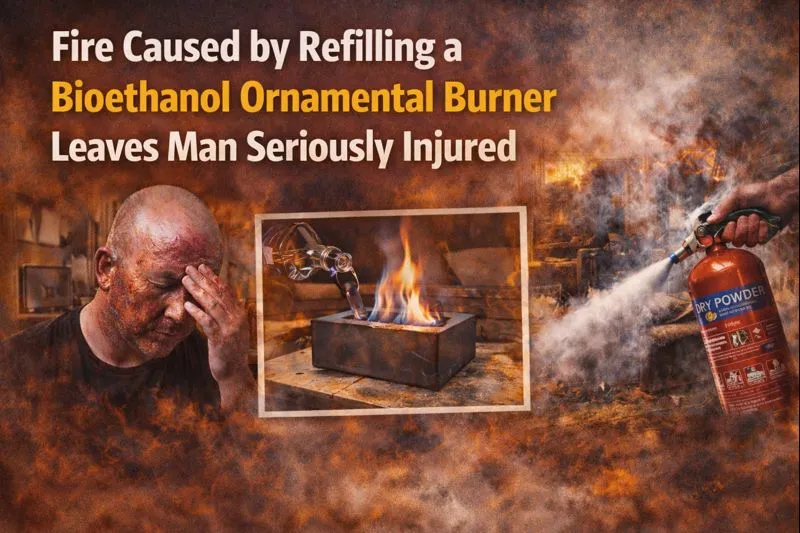
A serious domestic fire caused by the refilling of a bioethanol ornamental burner has highlighted the dangers associated with these increasingly popular decorative fire features, particularly when manufacturer safety guidance is not followed precisely.
The incident occurred at a terraced house, where the occupier suffered burns to his face after attempting to refill a bioethanol burner that he believed had gone out.
In reality, the flame was still alight — a common and dangerous misconception with bioethanol fires, where flames can be difficult to see in certain lighting conditions.
How the fire started
Fire investigators established that the occupier attempted to add liquid bioethanol fuel to the ornamental burner without realising it was still burning.
When the fuel was poured in, it ignited instantly, bursting into flames.
The sudden flare-up caused burning liquid fuel to spill onto nearby furniture and flooring, setting light to a settee and causing fire damage within the room.
The occupier sustained facial burns during the incident.
Unlike traditional fireplaces, bioethanol burners use highly flammable liquid fuel, which can flash rapidly when exposed to an ignition source. Even a small residual flame or hot vapour can be enough to ignite fresh fuel.
Early warning and swift action prevented a larger fire
A working smoke alarm activated quickly, alerting other occupants in the property.
They assisted the injured man with immediate first aid and used a dry powder fire extinguisher to put out the fire before it could spread further.
The casualty was taken to hospital by ambulance for treatment.
Fire and Rescue Service crews attended the scene to ensure the fire was fully extinguished and to assess the extent of the damage.
This incident could have been far more serious without:
- A working smoke alarm
- Other occupants being present
- Immediate access to a suitable fire extinguisher
Why bioethanol burners present a hidden fire risk
Bioethanol ornamental burners are often marketed as clean, modern and easy to use, but fire services regularly warn that they present unique and underestimated fire risks.
Key hazards include:
- Invisible or faint flames, particularly in daylight
- Extremely flammable liquid fuel
- Risk of flash fires during refilling
- Fuel spills that can ignite clothing, furniture or flooring
- Lack of physical separation between flame and surroundings
Unlike gas or electric fires, bioethanol burners rely heavily on user behaviour for safety. A single mistake can result in serious injury or fire spread.
A critical lesson: refuelling must never be rushed
In this case, the occupier believed the burner had gone out. This assumption proved dangerous.
Fire safety guidance is clear:
Never add fuel to a bioethanol burner unless you are absolutely certain the flame is fully extinguished and the burner has cooled down.
Manufacturers and fire services recommend leaving burners for at least 10 minutes after extinguishing before refuelling, to ensure no residual heat or flame remains.
Safety advice for bioethanol burners
This incident reinforces the importance of following manufacturer instructions exactly. Fire services recommend the following precautions:
- Always follow manufacturer guidelines
- Never add fuel to a burning fire
- Confirm the flame is fully extinguished and wait at least 10 minutes before refilling
- Never overfill the fuel reservoir
- Never leave a lit burner unattended
- Always extinguish burners when leaving a room or before sleeping, using the lid or flame killer provided
- Keep burners well away from combustible furnishings
- Keep burners out of reach of children and pets
- Regularly clean burners and check containers for damage
- Never use a leaking fuel container
- Place burners on a stable, level surface
- Use only in a well-ventilated room
- Never place hands into flames or fuel
- Clean fuel spills from skin or furnishings immediately with a damp cloth and dry thoroughly
- Light burners using an extended lighter or long match
- Never discard matches into the burner
Fire risk assessments and domestic fire safety
While this incident occurred in a domestic setting, it highlights principles equally relevant to rented accommodation, HMOs and managed properties.
Decorative heat sources, including bioethanol burners, should be considered carefully during fire risk assessments, particularly where:
- Multiple occupants are present
- Furniture and soft furnishings are close to ignition sources
- Users may be unfamiliar with safe operation
Professional fire risk assessments help identify whether such devices are appropriate for a property and what control measures are required to reduce risk.
Smoke alarms saved lives
A key positive outcome in this incident was the presence of a working smoke alarm, which provided early warning and prevented the fire from escalating.
Fire services consistently advise:
- Smoke alarms on every level of a home
- Regular testing
- Never disabling or removing batteries
A preventable incident with lasting consequences
This fire was entirely preventable. A moment’s misjudgement during refuelling resulted in serious injury, property damage and hospitalisation.
The original case study can be found here:
🔗 https://www.heads-up.biz/bio-ethanol-ornamental-burner
Bioethanol burners can be used safely, but only when users fully understand the risks and follow guidance without exception.
Fires involving liquid fuels escalate rapidly — and as this incident shows, they leave little margin for error.