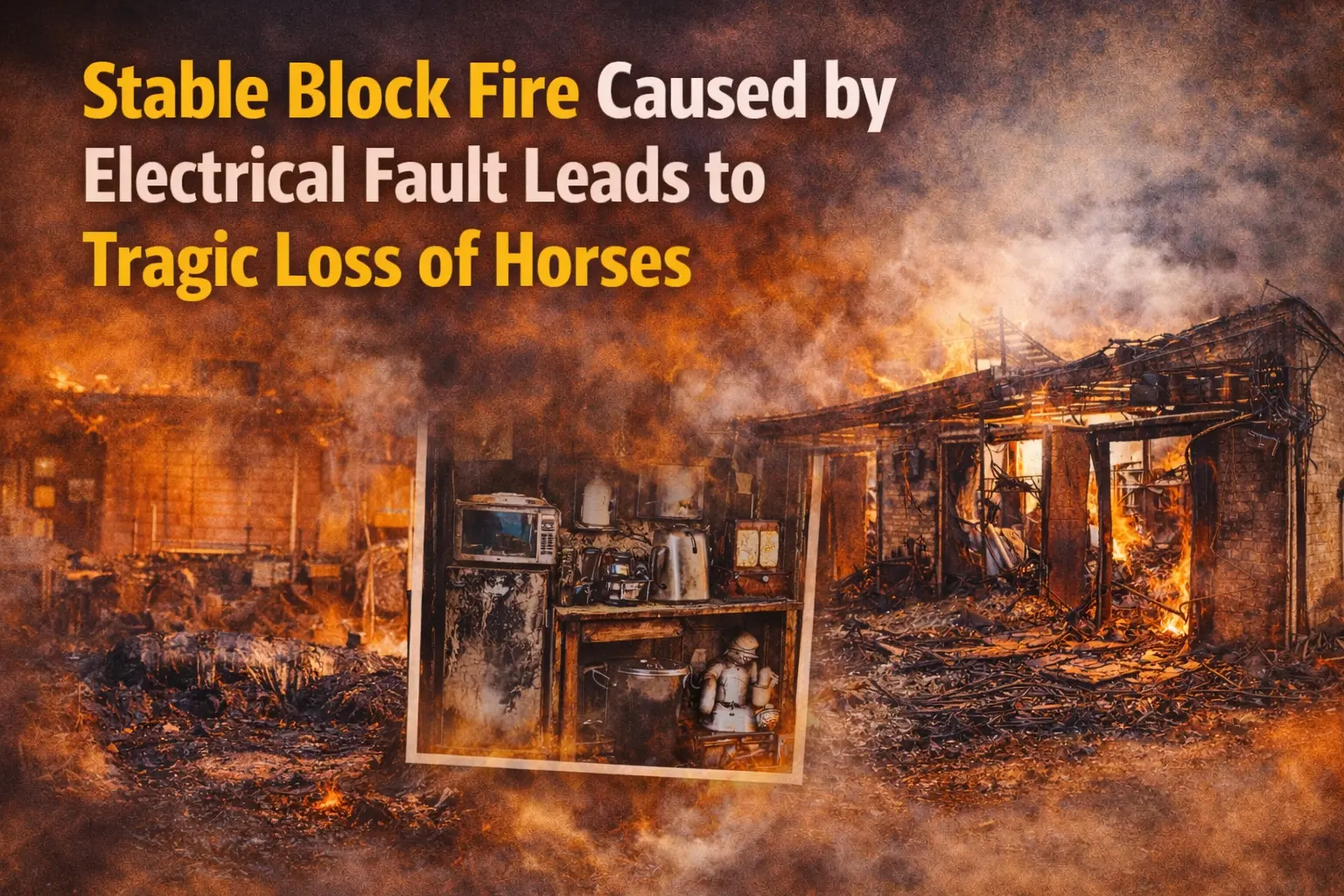
A devastating fire at a livery yard stable block, caused by an electrical fault in a tack room, has resulted in the tragic loss of several horses and the destruction of buildings and irreplaceable possessions.
The incident underscores the unique and heightened fire risks in stables and equestrian premises, and the importance of professional, site-specific fire risk assessments rather than generic or assumptions-based approaches.
The fire occurred in the early hours of a windy December night, when the yard was unoccupied.
By the time the alarm was raised, the fire had already taken hold, spreading rapidly through the stable structure with catastrophic consequences.
How the fire started
A fire investigation concluded that the blaze originated in the tack room, which housed a number of electrical kitchen-style appliances.
An electrical fault was identified as the cause.
The yard owner had taken sensible precautions, ensuring appliances were only used when someone was present.
However, this incident shows that procedural controls alone are not sufficient in high-risk environments.
Electrical components can fail unexpectedly, particularly in areas where dust, moisture and combustible materials are present.
The fire started when no one was on site. It was a neighbour and a passing motorist who raised the alarm, by which point the fire was already well developed.
Wind, ventilation and rapid fire spread
Strong winds played a decisive role. Increased airflow ventilated the fire, allowing it to intensify quickly, while gusts accelerated spread through the building.
As with many stables, the structure included combustible materials such as timber frames and wooden boarding, which further increased the speed and severity of fire development. Although firefighters eventually extinguished the blaze, the stable block, store room and tack room were destroyed, and a number of horses did not survive.
The human impact behind the incident
An occupant impact statement highlights the profound emotional toll. Woken at 2.25am by a neighbour warning of the fire, the owner described seeing flames through the glass and experiencing immediate panic. Despite the prompt arrival of the fire service, the sight of the building completely gutted, with no horses visible over the doors, was described as “the worst experience of my life.”
Alongside the loss of three horses, the fire destroyed 26 years’ worth of possessions in the tack room. The psychological effects — sleeplessness and flashbacks — continued long after the fire was out, illustrating that fires in animal premises cause long-lasting trauma, not just physical loss.
Why stables carry a higher fire risk
Fire services consistently identify stables as higher-risk due to:
- Secluded, rural locations, delaying detection
- Combustible construction, often timber-based
- Storage of highly flammable materials (hay, straw, feed, rugs, bedding)
- Electrical equipment operating amid dust, moisture and pests
Animals cannot raise the alarm, making early detection and robust prevention critical.
Electrical safety in tack rooms and stores
Electrical faults remain a leading cause of fires in agricultural and animal premises. Failures can occur due to aging equipment, overheating components, damaged wiring or unsuitable appliances for the environment.
Good practice includes:
- Keeping appliances and wiring in good repair
- Regular inspection by competent persons
- Avoiding overloaded sockets
- Locating appliances away from equine accommodation and combustibles
The value of fire risk assessments — and why “site-specific” matters
Unless a stable is single and privately occupied, equestrian premises fall under the Regulatory Reform (Fire Safety) Order 2005, requiring a suitable and sufficient fire risk assessment.
Crucially, stables demand a site-specific assessment. Generic templates rarely capture the realities of:
- Building layout and materials
- Ventilation effects (including wind exposure)
- Electrical installations in dusty environments
- Storage practices and separation distances
- Night-time occupancy and detection limitations
- Emergency arrangements for animals and people
- Arson risk in isolated locations
A professional assessment tailored to the site can identify practical, proportionate controls — from relocating appliances and improving detection, to compartmentation, improved storage arrangements, and realistic emergency plans.
Government guidance is available at:
🔗 GOV.UK – Fire safety risk assessment: animal premises and stables
https://www.gov.uk/government/publications/fire-safety-risk-assessment-animal-premises-and-stables
Further sector-specific insight is also provided in Guidelines for Fire Safety in Equine and Agricultural Premises by Harry Paviour, widely used by proprietors of equestrian establishments.
Reducing risk through a layered, professional approach
Fire risk in stables cannot be eliminated, but it can be significantly reduced through:
- Professional fire risk assessments reviewed regularly
- Electrical maintenance regimes appropriate to the environment
- Separation and safe storage of combustibles
- Suitable fire detection systems for stables
- Consideration of fire suppression options designed for animal premises
- Clear management controls and emergency planning
This case study, provided by Hampshire Fire and Rescue Service, shows that even well-run yards can suffer devastating losses without early detection and engineered controls informed by a thorough, site-specific assessment.
A tragic but vital lesson
The loss of animal life, livelihoods and treasured possessions demonstrates why fire safety in stables must go beyond good intentions.
Professional, site-specific fire risk assessments, combined with appropriate maintenance and detection, remain the most effective way to identify hidden risks and prevent similar tragedies.
Fire safety in equestrian premises is not about paperwork — it is about understanding the site, the hazards and the consequences, and putting the right controls in place before the unexpected happens.
Get professional, site-specific fire safety advice
Fires in stables and equestrian premises show that generic fire safety approaches are not enough. Every site is different, and risks need to be assessed in the context of how buildings are constructed, used and managed.
ESI: Fire Safety provides professional, site-specific fire risk assessments for stables, livery yards and animal premises, helping owners and responsible persons understand real-world risks and implement practical, proportionate fire safety measures.
If you are responsible for an equestrian premises and want expert guidance tailored to your site — not a template — contact ESI: Fire Safety to discuss a compliant, risk-based approach to protecting people, animals and property.