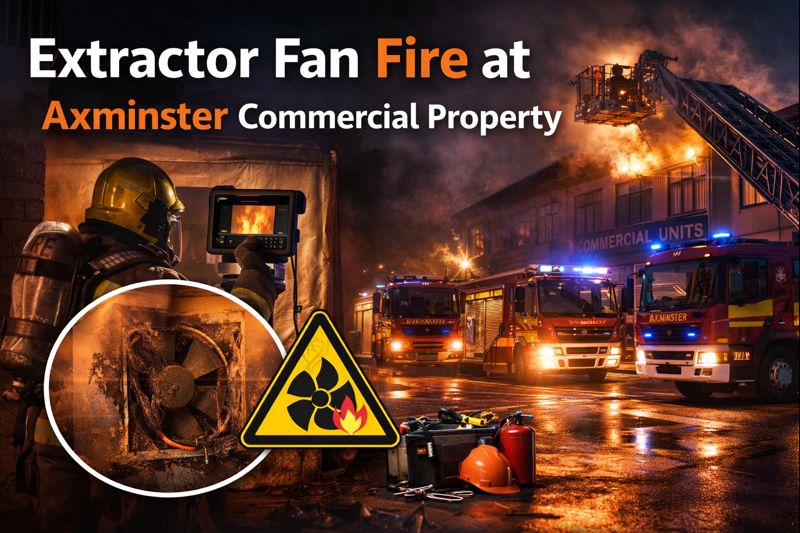
Firefighters from across East Devon were called to a commercial property in Axminster after reports of a smell of burning led to the discovery of a smouldering extractor fan hidden within the building’s loft space. While the incident was brought under control without injury, fire services say it highlights the real fire risks posed by poorly maintained ventilation and electrical equipment — and the significant resources required when faults escalate into emergency call-outs.
The incident occurred on Wednesday 3 September at a commercial premises on Trafalgar Way, Axminster, prompting a multi-crew response from the Devon and Somerset Fire and Rescue Service (DSFRS).
What happened in Axminster?
According to DSFRS, the alarm was raised after occupants reported a strong smell of burning coming from the first floor of the building. Fire appliances were mobilised from Axminster, Colyton and Charmouth, supported by an aerial ladder platform from Danes Castle in Exeter.
On arrival, crews found:
- Fire alarms sounding
- A noticeable smell of smoke
- Light smoke accumulating within the property
Firefighters wearing breathing apparatus entered the building to investigate further. Using a thermal imaging camera, crews traced the source of heat to the loft space, where they discovered an extractor fan that had burnt out and was smouldering.
The affected equipment was safely isolated, and the area was made secure. Thankfully, no injuries were reported, and the incident was prevented from developing into a more serious fire.
Extractor fans: a hidden ignition risk
Extractor fans are a common feature in commercial properties, often installed in toilets, kitchens, workshops and production areas. However, because they are typically located in ceiling voids or loft spaces, they can fail out of sight, allowing heat and smoke to build unnoticed.
Fire services across the UK consistently report extractor fans as a recurring ignition source, particularly where:
- Motors overheat or fail
- Dust, grease or lint accumulates internally
- Electrical connections degrade over time
- Fans operate continuously without inspection
In many cases, fires are only detected once smoke spreads or alarms activate — by which point emergency resources are already required.
The role of thermal imaging and early intervention
In the Axminster incident, the use of thermal imaging equipment allowed firefighters to quickly locate the source of heat before flames developed. This technology is increasingly vital in preventing concealed fires from spreading through roof voids, ductwork and adjoining compartments.
Without early intervention, a smouldering extractor fan can ignite surrounding materials such as insulation, timber or accumulated debris, potentially leading to:
- Rapid fire spread through loft spaces
- Smoke contamination across multiple floors
- Structural damage
- Business disruption and evacuation
The cost of emergency response
Although no one was injured, incidents like this carry a significant cost in fire service resources. Multiple appliances, specialist equipment, breathing apparatus crews and aerial platforms were deployed to a single electrical fault.
Each emergency call-out places demands on:
- Firefighters’ time and availability
- Specialist equipment and vehicles
- Operational budgets funded by the public
Fire services regularly stress that many of these incidents are preventable through effective risk management and routine maintenance, reducing unnecessary strain on emergency services.
Fire risk assessments: identifying the risk before it ignites
This incident reinforces the importance of ensuring that extractor fans and ventilation systems are included within a suitable and sufficient fire risk assessment.
Under the Regulatory Reform (Fire Safety) Order 2005, responsible persons for commercial premises must identify potential ignition sources and take reasonable steps to reduce fire risk.
A robust fire risk assessment should consider:
- The type and location of extractor fans
- Whether fans are suitable for continuous or high-duty use
- The risk of dust, grease or lint accumulation
- Access for inspection and cleaning
- The potential for fire and smoke spread through voids and ducting
Where extractor fans are hidden in loft spaces, the risk can be easily overlooked unless assessments are thorough and regularly reviewed.
Maintenance: the most effective control measure
Routine maintenance remains one of the most effective ways to prevent extractor fan fires. In commercial properties, this should form part of a planned preventive maintenance programme, rather than being addressed only after faults occur.
Good practice includes:
- Periodic internal cleaning of fans and ductwork
- Electrical checks on motors, bearings and wiring
- Prompt replacement of overheating, noisy or aging fans
- Clear maintenance records demonstrating compliance
Fire investigations frequently reveal that fans involved in fires had no documented inspection history, or were long past their intended service life.
Lessons for business owners and duty holders
The Axminster incident ended without injury or major damage, but it could easily have escalated into a serious fire. For business owners, landlords and facilities managers, it serves as a reminder that small electrical faults can trigger large emergency responses.
Extractor fans should never be treated as “fit and forget” equipment. When their risks are identified through fire risk assessments and controlled through routine maintenance, the likelihood of emergency call-outs is significantly reduced.
Official source
The original report was published by the Midweek Herald and can be read here:
🔗 Fire crews deal with Axminster extractor fan fire – Midweek Herald
https://www.midweekherald.co.uk/news/25439696.fire-crews-deal-axminster-extractor-fan-fire/
A preventable outcome
Incidents like this show how easily a hidden fault can mobilise multiple fire crews and disrupt businesses.
With proper fire risk assessments, regular maintenance routines and timely replacement of aging equipment, many extractor fan fires can be prevented before emergency services are ever needed.
For commercial premises, proactive fire safety management is not just about compliance — it is about protecting people, property and public resources.